
An 81-page field manual for the people who live with a bolted steel water tank after the contractor leaves. It digests ANSI/AWWA D103-19 into the requirements that explain what you see on the tank, then adds 20 what-if scenarios, printable component checklists, and a maintenance program built on the annual, biennial and five-year rhythm.
Free to download, print and circulate to your operations staff. Appendices E–G are blank log and data-sheet templates meant to be copied for your own tank file.
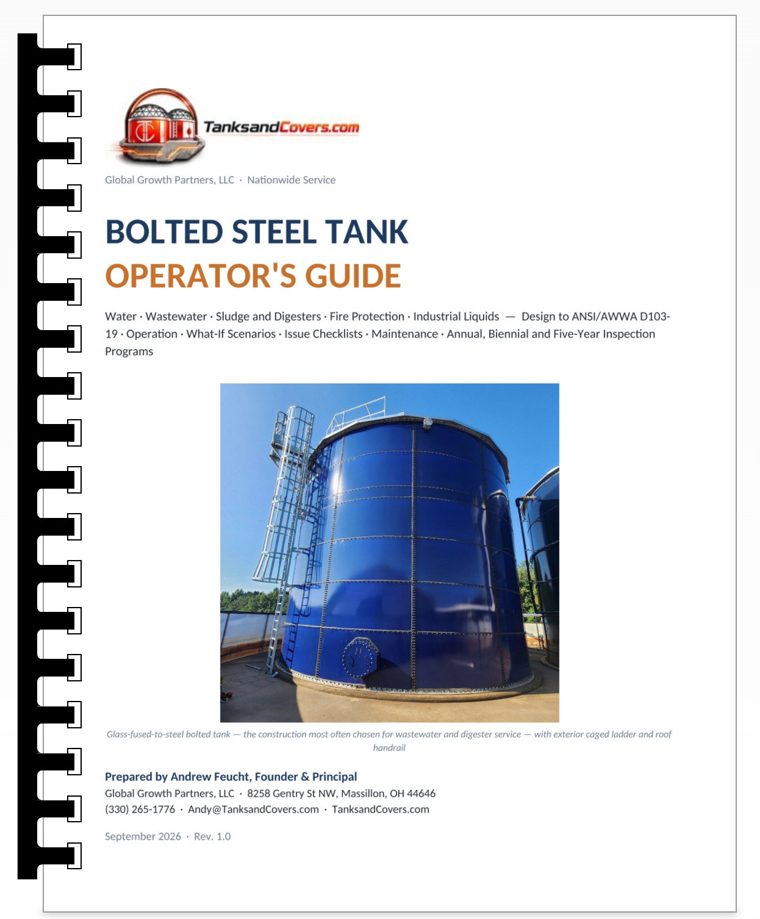
It is laid out as a working reference rather than a brochure: a running head on every page naming the document and the standard, tables that map D103 section numbers to what they govern, shaded callouts for the things operators most often have to go find, and numbered figures, photos and detail sheets you can cite in a work order. The two spreads below are reproduced at full size — click either one to read it before you download.
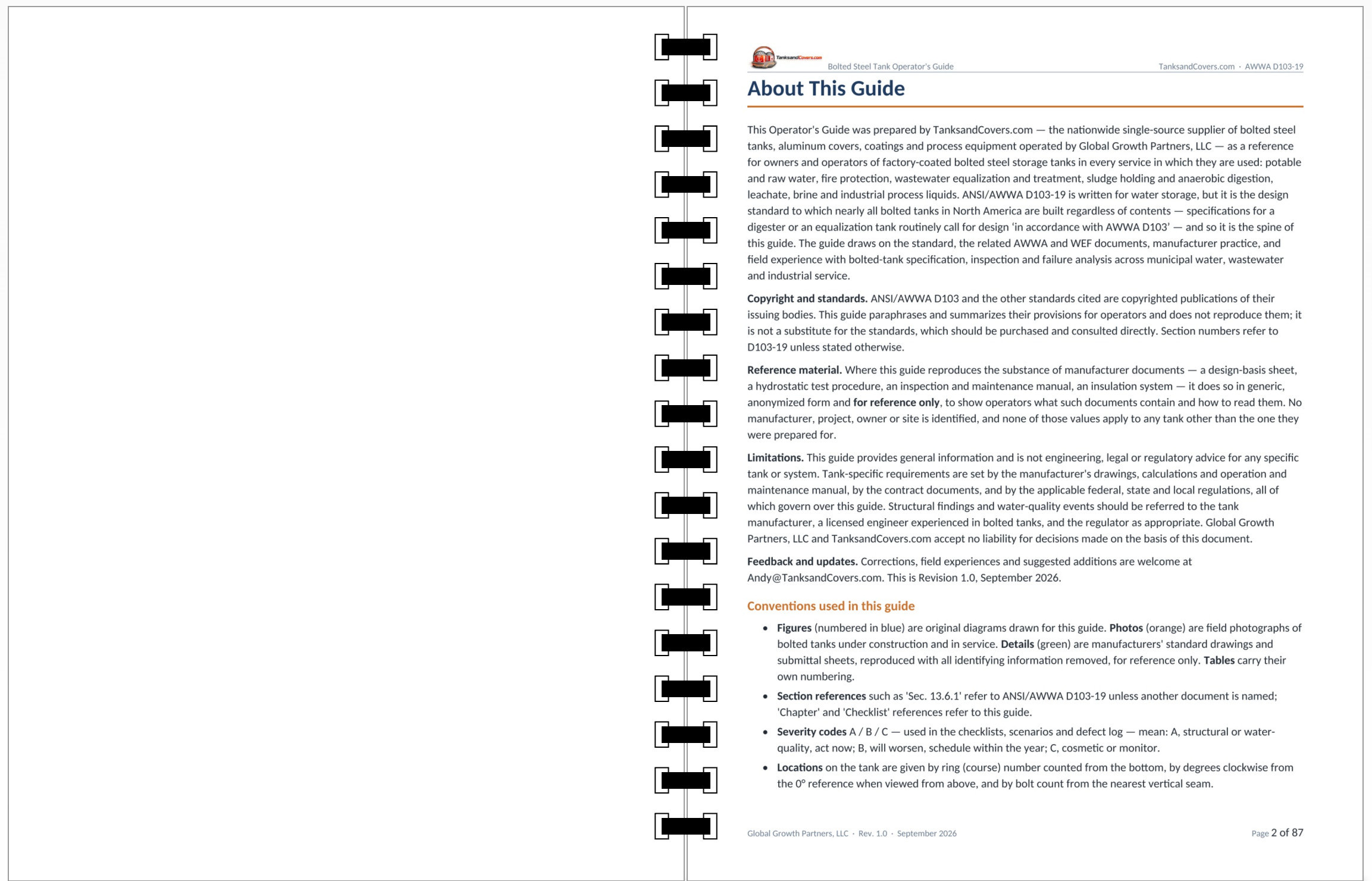
The front matter tells you exactly what you are holding: who wrote it, which services it covers, that it paraphrases rather than reproduces the copyrighted standards, and that every reference document shown in it has been anonymized and is included to show you what such a document contains — not to specify your tank.
The conventions list is worth reading once. It sets the numbering for figures, photos, details and tables, fixes what a bare section reference like ‘Sec. 13.6.1’ points at, defines the A / B / C severity codes used in every checklist and scenario, and establishes how a location on the tank is written down — ring number from the bottom, degrees clockwise from the 0° reference, bolt count from the nearest vertical seam.
Open full size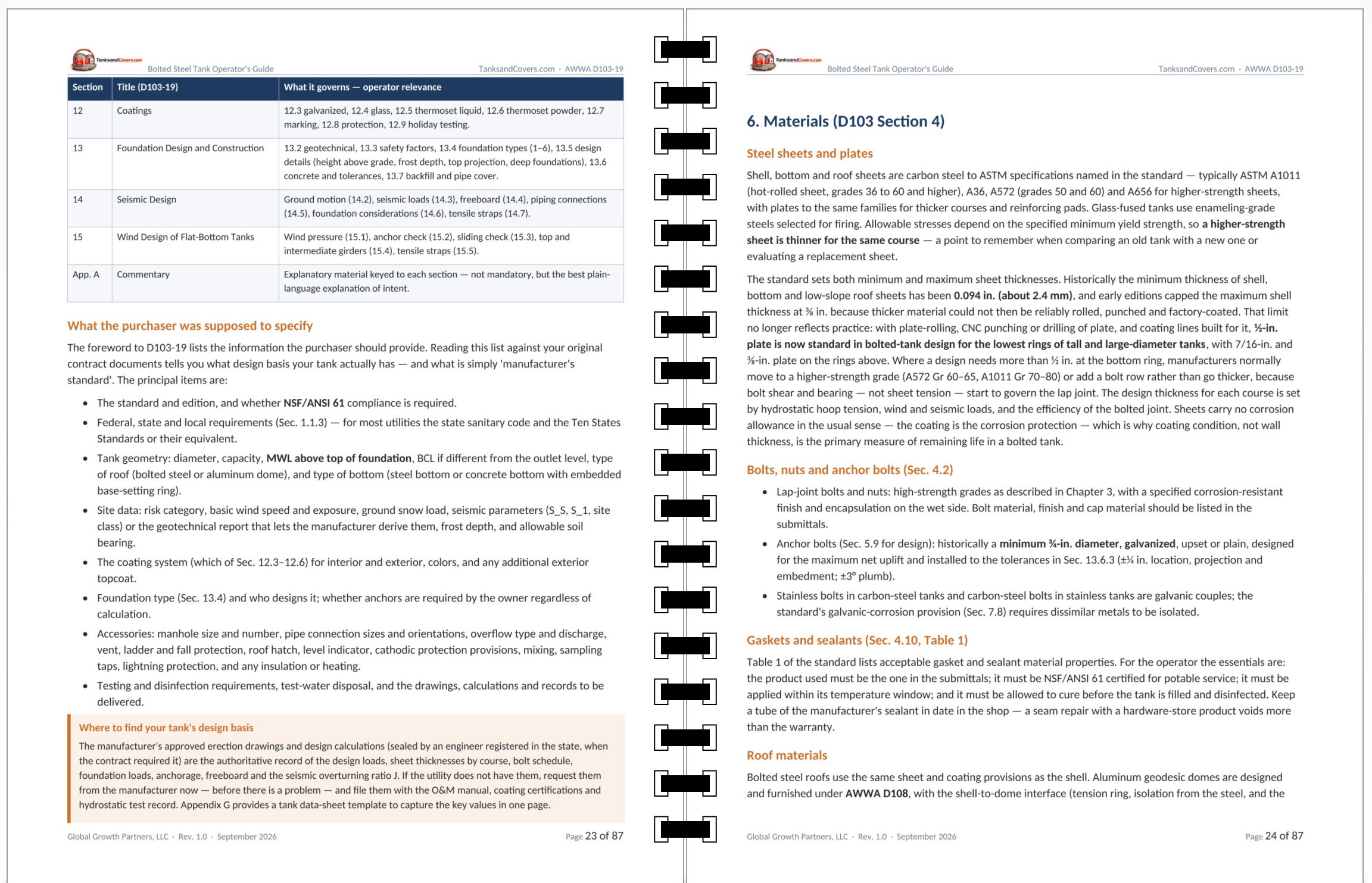
On the left, the tail of the section-by-section map of the standard — coatings, foundation design and construction, seismic, wind, and the commentary appendix — each row saying what that section governs and why an operator cares. Under it, “What the purchaser was supposed to specify”: read that list against your own contract documents and you learn which parts of your tank were specified and which are simply manufacturer’s standard.
On the right, the Materials chapter opens with the point most owners are surprised by — a higher-strength sheet is thinner for the same course, sheets carry no corrosion allowance, and it is coating condition rather than wall thickness that measures remaining life in a bolted tank.
Open full sizeA bolted tank is not a welded tank with different fasteners. Its coating is finished in the factory, its watertightness lives in a sealed lap joint under bolt clamp, and its maintenance is almost entirely inspection plus small, timely repair. This guide is written around that distinction, so an operator can tell the difference between a weeping fillet that can wait for a planned repair and a finding that has to be escalated today.
Part II walks the standard section by section — materials, general design, sizing and accessories, fabrication and testing, coatings, foundations, seismic and wind — so you can find the requirement behind what is on your drawings.
Twenty scenarios — leaks, overflow, iced vents, high wind, earthquake, settlement, a coliform hit, a gunshot hole — each with what you see, what it usually means, what to do now, what not to do, and the follow-up.
Six component checklists by inspection zone, each line naming a condition and what acceptable looks like, with an A/B/C severity convention that carries findings from one audit into the next.
A ten-year calendar with who does what at each interval, plus a relative cost table showing what each activity avoids — from a $0 walk-down to the re-lining campaign the program is designed to prevent.
Glass-fused-to-steel, thermoset powder (FBE), thermoset liquid, hot-dip galvanized and bolted stainless — compared by how each coating actually fails and how each is repaired in the field.
An inspection log, a defect log with reference photo points, a tank data sheet, a glossary, a D103 key-numbers table, and hydrostatic and unit conversions — ready to copy and fill in.
The guide is organized so it can be read straight through once and then used as a reference forever after. Each part stands on its own.
What a bolted tank is and why it behaves differently: the lap joint, the bolts, the sealants and gaskets, and the coating systems D103 recognizes. Includes how a submittal drawing set is organized, how to review one as an owner, the 0° shell-location convention used throughout the guide, and the difference between nominal and actual dimensions.
An operator’s digest of the standard: materials (Sec. 4), general design (Sec. 5), sizing and accessories (Sec. 6–7), fabrication, erection, inspection and testing (Sec. 8–11), coatings (Sec. 12), foundations (Sec. 13), seismic (Sec. 14) and wind (Sec. 15) — with what the purchaser was supposed to specify in the first place.
Commissioning and the tank file; levels, alarms and the overflow; turnover and water quality; security and access; cold-weather operation; insulated tanks; and whether a factory-coated bolted tank actually needs cathodic protection.
Triage first — the three questions that come before every scenario — then a notification matrix naming who to call, when, and what they need from you: supervisor, manufacturer service line, state drinking-water program, structural engineer, law enforcement, insurer.
Printable checklists by inspection zone, with field discipline that makes the record usable: walk the same route every time, tick every line (an unticked line is uninspected, not clean), photograph before touching, and give every finding a severity the same day.
The ten-year calendar and what it costs; what the manufacturer’s own manual typically requires and where those intervals are conditions of the warranty; routine and quarterly tasks; the annual exterior audit; the biennial detailed audit; the five-year comprehensive inspection; repair procedures; cleaning and disinfection; and records.
Every scenario follows the same five headings — what you see, what it usually means, do now, do not, afterwards — and ends with a record entry and the standards it draws on.
Bolted tanks are low-maintenance structures, not no-maintenance structures. Because the coating is applied in the factory, the two largest costs in a welded tank’s life — periodic blasting and field recoating — are largely absent. In their place is a steady, predictable program of small items on a fixed calendar, with a defect log that carries findings forward.
| Activity | Frequency | Who | Scope in brief |
|---|---|---|---|
| Routine visit | Weekly to monthly | Operator | Walk the base, glance at the overflow and vent, verify level and alarms, check the hatch lock, read the CP rectifier, note anything new. |
| Quarterly walk-down | Every 3 months, and after any storm, freeze or earthquake | Operator | Full exterior circuit at base level with a camera; roof visit if safe; overflow test; vent check; sealant and bolt-cap scan of the lower courses. |
| Annual exterior audit | Every 12 months, shoulder season | Utility maintenance lead or consultant | Checklists 19–23 in full; roof and dome; ladder and fall protection; instrument calibration; CP; defect-log review; report. |
| Biennial detailed audit | Every 24 months (replaces that year’s annual) | Consultant or trained utility inspector | Annual audit plus torque sampling, coating DFT and adhesion spot checks, settlement survey, drone/photo survey, interior look from the hatch, CP potential survey, records and design-basis review. |
| Five-year comprehensive inspection | Every 60 months (some states 36) | Qualified tank inspector; ROV/diver contractor or drain-down crew | Everything above plus the full interior, coating survey, sediment, structural review, and a condition report with a repair plan and a re-lining outlook. |
| Cleaning | 3–5 years, or as water quality dictates | Contractor or utility | Sediment removal, floor and lower-shell wash-down within coating limits, disinfection per AWWA C652, return to service. |
| Coating condition survey | At the five-year inspection; annually once the survey shows systemic loss | AMPP/SSPC-certified coating inspector | DFT, holiday and adhesion testing by zone, with a remaining-life estimate. |
Appendix B collects the values cited throughout the guide into a single quick-reference table with the section each one comes from. A sample is below; the guide carries the full table.
| Item | Value | Where |
|---|---|---|
| Minimum sheet thickness (shell, bottom, low-slope roof) | 0.094 in. (2.4 mm) | Sec. 5 (historic value) |
| Minimum roof live load | 15 psf, or ASCE 7 snow if greater | Sec. 5 |
| Shell manway | ≥ 24 in. dia. or equivalent | Sec. 7.1 |
| Roof hatch | ≥ 24 in. clear; curb ≥ 4 in.; cover overlap ≥ 2 in. | Sec. 7.6 |
| Foundation top above grade | ≥ 6 in. | Sec. 13.5.1 |
| Foundation levelness | ±⅛ in. in any 30 ft; ±¼ in. from plane | Sec. 13.6.1 |
| Seismic design not required when | S₁ ≤ 0.04 g and SS ≤ 0.15 g | Sec. 14.1.1 |
| Overturning ratio J thresholds | ≤ 0.785 no uplift; 0.785–1.54 self-anchored with checks; > 1.54 anchor | Eq. 14-32 |
| Hydrostatic pressure | 0.433 psi per ft of water depth | Appendix D |
| Cathodic protection criterion | −850 mV vs. Cu/CuSO₄ polarized, or a 100 mV shift | AWWA D104 / D106 |
| Disinfection, C652 Method 1 | 10 mg/L free chlorine for 6 h, or 6 mg/L for 24 h | AWWA C652 |
The guide ends with a one-page summary meant to be printed and posted in the control building. It is reproduced here in full — if it is the only page your staff reads, it is the right page.
Corrosion protection is a factory film a few thousandths of an inch thick; every inspection is first a coating inspection.
Caps, fillets and tightness are the maintenance items; wall thickness is not.
Snug-tight or a stated torque — never a generic chart.
And only products certified to NSF/ANSI 61 in potable service.
without the manufacturer’s written approval; added load voids the warranty and may exceed the design.
The freeboard is for the seismic wave and the overflow, not for storage.
A blocked screen collapses a roof; a blocked overflow floods one.
from the 0° mark, with a photograph and a severity. The trend is the diagnosis.
Seams monthly, exterior annually, interior every two years where the manufacturer requires it and never less than every five.
Wind, snow, seismic, capacity, anchorage and the ring schedule are all on one page; if the site or the service has changed, the design basis may no longer fit.
The back of the guide is the part that gets used. Appendices E, F and G are blank forms — copy them, fill them in for your tank, and the annual audit has somewhere to land.
From base angle and BCL to joint efficiency, impulsive component, Type 1–6 foundation, tension ring and splash zone.
A single quick-reference table of every value cited in the guide, with the section it comes from.
AWWA D103, D104, D106, D108, C652 and Manual M42, plus the ASCE, ASTM, SSPC/AMPP, NSF and NFPA documents cited.
Head, pressure and unit conversions for the arithmetic that comes up during a drain-down or a hydrotest.
Blank log covering the routine, quarterly, annual, biennial and five-year entries.
Location by ring, seam and degrees, with severity and the marked photo stations that let you compare year over year.
One page for the design basis: capacity, roof type, wind, snow, seismic, anchorage, bolt grade and torque, sealant product, vent and overflow capacity, instrument and alarm set-points, inspection dates and warranty terms.
The postable one-pager, and who to call for what: manufacturer, state drinking-water program, structural engineer, coating inspector.
The guide summarizes and paraphrases ANSI/AWWA D103-19 and the related AWWA standards for operators. It does not reproduce them and is not a substitute for them — the standards are copyrighted publications of their issuing bodies and should be purchased and consulted directly. Where the guide shows the substance of a manufacturer document, it does so in generic, anonymized form for reference only; no manufacturer, project, owner or site is identified.
Nothing in the guide is engineering, legal or regulatory advice for a specific tank. Your manufacturer’s drawings, calculations and O&M manual, your contract documents, and the applicable federal, state and local regulations govern. Structural findings call for the manufacturer or a licensed structural engineer experienced in bolted tanks; water-quality events call for your regulator’s requirements first.
81 pages, free, no registration and no email wall. Print Parts IV and V for the truck, post Appendix H in the control building, and copy Appendices E–G into your tank file.
Annual, biennial and five-year inspections, drain-down or ROV, with the condition report and repair plan the guide’s Part VI calls for.
Inspection servicesThe diagnostic behind Part IV: symptoms, mechanisms and the repair decision for the failure modes bolted tanks actually experience.
Failure analysisPut numbers on the relative cost table in Chapter 25 — maintenance, recoating and replacement over a tank’s life.
Run the modelProduct brochures and editable CSI-format bolted tank specifications for potable water, wastewater, fire protection and stainless service.
All downloads