
A coating holiday is a breach in a tank's interior lining — the start of corrosion. HolidayGuard turns the tank's own sacrificial anodes into a continuous sensor that finds the breach while the tank stays in service, and pinpoints the zone it's in.
The conventional way to find a lining defect is to take the tank out of service, drain it, and send an inspector inside. By then the breach has often been corroding for months. HolidayGuard watches continuously instead — no draining, no entry, no guesswork about which panel failed.
In the coatings and cathodic-protection trade, a "holiday" is a pinhole, scratch, or void that exposes bare steel to the electrolyte — exactly what holiday detection and high-voltage holiday testing look for. HolidayGuard is named for the defect it's built to catch.
A sacrificial anode is resistance-controlled: its current output rises in direct proportion to the bare-steel area exposed at a breach. Measure that current per zone, cross-check the protection potential, and analyze the trend — and routine CP hardware becomes an early-warning instrument.
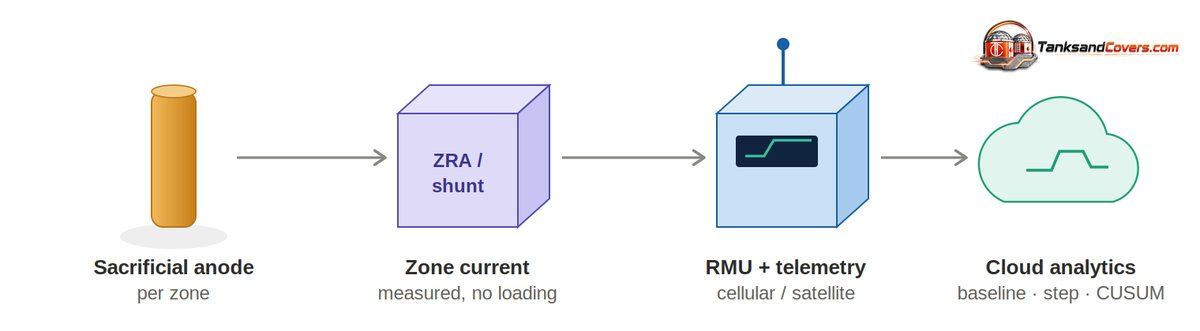
Each anode zone reports through a zero-resistance ammeter or calibrated shunt — no loading on the protection it's measuring.
A permanent reference electrode cross-checks polarization against the −0.85 V (CSE) / 100 mV criteria, so a current shift is confirmed, not guessed.
The RMU runs a temperature-normalized baseline with step (≈3σ) and CUSUM drift detection — catching both sudden breaches and slow decline.
A high-current event raises a breach alarm tied to its zone; a low-current trend flags anode depletion. Alarms push to cloud and SCADA.
HolidayGuard uses cast AZ63 magnesium rod anodes set low at the base of the shell — ground-mounted and landed directly into the lower sidewall through an insulated boss, with a steel-core connection. Distributed around the perimeter and grouped into monitoring zones, they protect the tank and sense it at the same time.
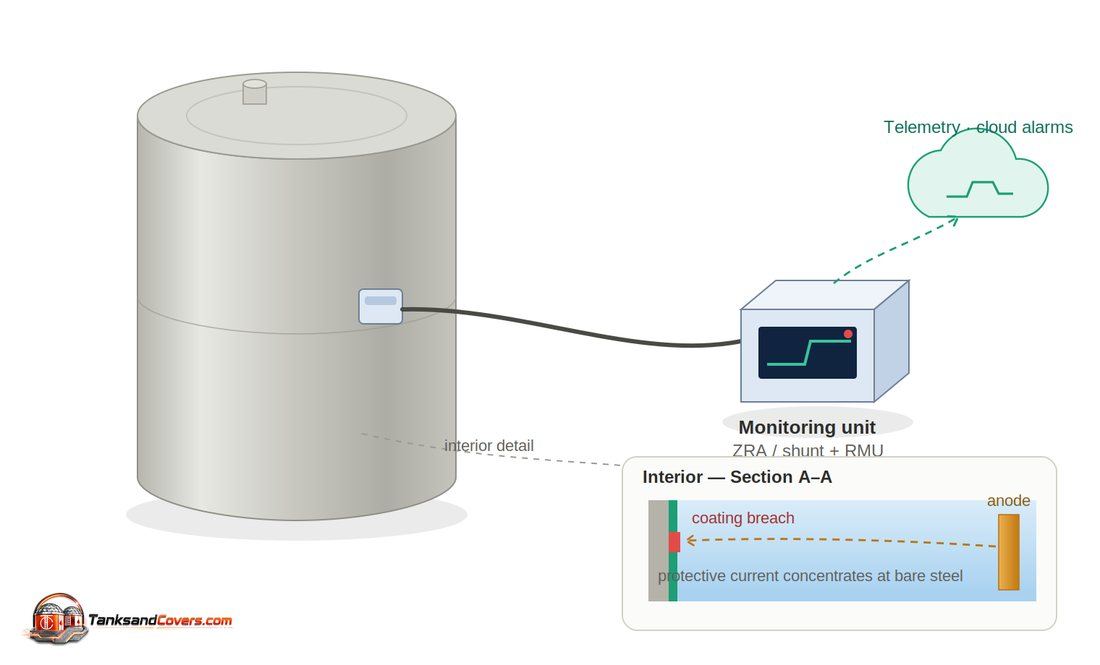
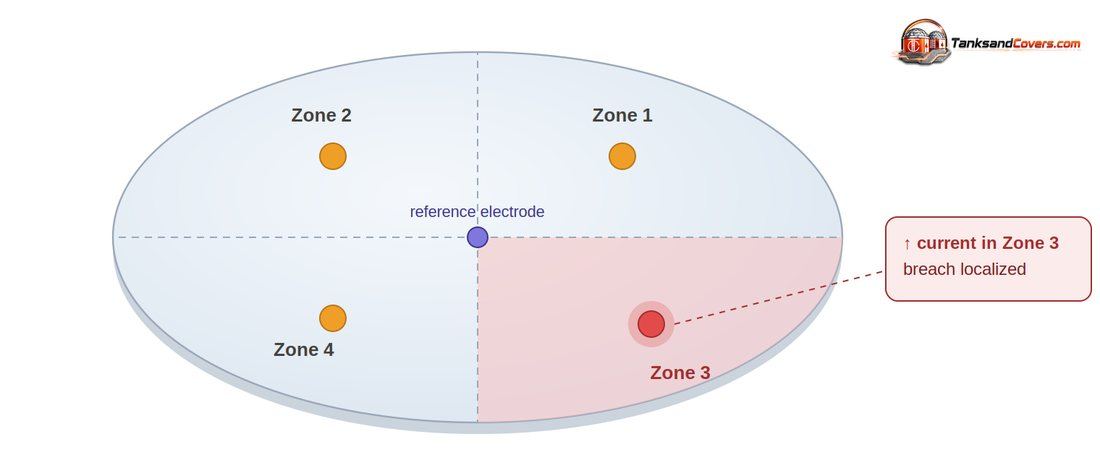
The tank is divided into monitoring zones, each with its own measured anode current. When a holiday opens, the current rises in that sector first, so the alarm names the zone instead of the whole tank — turning a full-tank shutdown-and-search into a targeted repair.
An interactive cutaway of a coated steel tank with its perimeter ring of AZ63 anodes and zoned monitoring. Orbit the model, toggle a coating breach, and see how protective current concentrates at the holiday and lights up the affected zone.
This is the part of the claim that usually stays a claim. Below is a working simulation of the monitor: eight zone currents, the differential that throws away temperature drift, the CUSUM statistic that decides when a change is real, and the reference-cell potential checked against the −850 mV criterion. Choose a breach size, pick a zone, and open it. Then try the pinhole — it stays quiet, because that is the truth about what current-based monitoring can and cannot resolve.
Absolute current thresholds fail because water temperature and resistivity move every zone at once. Turn the drift toggle off and on: the raw traces breathe, and the differential does not. That is why the alarm limit lives on the differential.
A coating breach raises current. An open anode lead or a consumed anode lowers it. The detector runs both tails, so an installation that quietly stopped protecting the tank raises its own alarm instead of reading as healthy.
The floor is set by measurement noise, not marketing: roughly a quarter of a square foot of newly exposed steel, sustained. A single pinhole is below it. What the system catches is the failure that is actually going to perforate a wall.
HolidayGuard reads a galvanic signal that other monitoring approaches mask — and wraps it in analytics and alarms that an operator can act on.
Sacrificial anodes aren't auto-regulated, so coating change shows up directly in the current — the very thing impressed-current systems hide.
Per-zone measurement points the alarm at the sector that breached, not the whole tank.
Temperature-normalized trending with step and drift detection catches both sudden holidays and slow decline. Watch the detector fire →
A permanent reference electrode confirms protection against the standard −0.85 V / 100 mV criteria.
Alerts reach a dashboard and your control system over cellular or satellite — no site visit to know the tank's state.
Wetted components specified to NSF/ANSI 61 for drinking-water storage.
HolidayGuard is designed around recognized cathodic-protection and potable-water standards. Final design is set by a qualified CP specialist (AMPP) or PE for your tank and water chemistry.
Ground storage and standpipes where draining for inspection means lost service.
Process and storage tanks in aggressive, variable-chemistry service.
Bolted and welded steel digester tanks where interior access is costly and rare.
Coated carbon-steel tanks where an unplanned lining failure is expensive.
Shown for a 60 ft × 25 ft coated-steel potable tank. Anode count, zoning, and the galvanic-vs-impressed-current decision are set per measured water resistivity.
Tell us about your tank — size, coating, service, and water chemistry — and TanksandCovers.com will scope a HolidayGuard configuration and assessment for it.