
Every tank-material decision flows downstream from one question: how does the tank wall resist the water it holds, and what happens when that defense is breached?
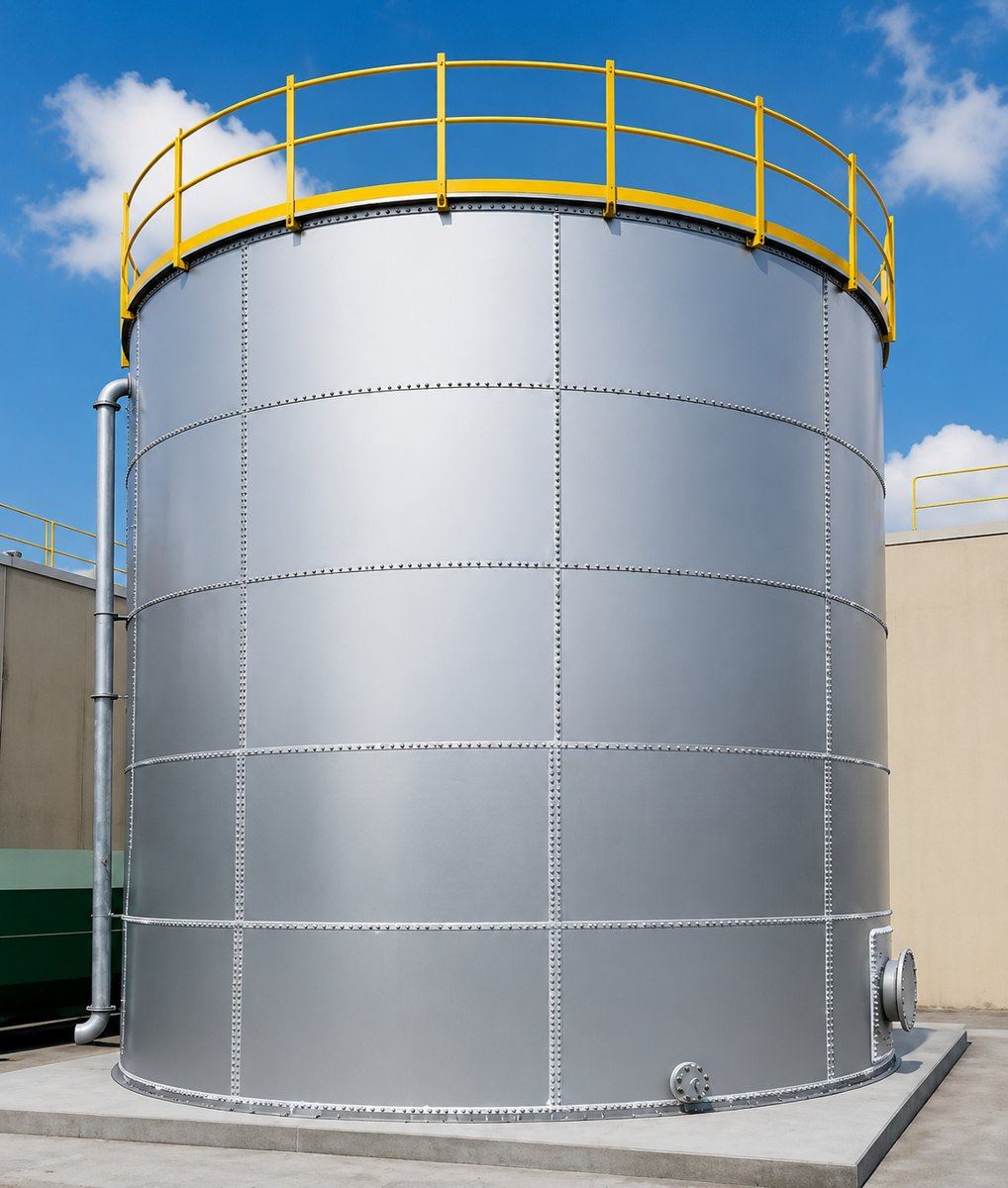
This is where stainless steel separates itself from glass-fused-to-steel (GFS) and concrete. Stainless doesn't rely on a barrier applied over a vulnerable substrate. Its corrosion resistance is a bulk property of the metal itself. That single distinction drives nearly every lifecycle advantage discussed below.
01 Two philosophies of corrosion protection
Tank materials fall into two camps.
Coating-dependent systems (GFS, painted carbon steel, and to a degree concrete) place a thin protective layer between a corrodible substrate and the water. Protection is only as good as the integrity of that layer. A holiday, chip, or crack is a direct path to the substrate — and the substrate underneath has essentially zero corrosion resistance on its own.
Inherently passive systems (stainless steel) carry their corrosion resistance throughout the full thickness of the wall. There is no substrate to expose, because the substrate is the corrosion-resistant material.
Stainless develops a self-healing passive film — a chromium-rich oxide layer (predominantly Cr₂O₃) only 1–3 nanometers thick — that reforms spontaneously in the presence of oxygen whenever the surface is scratched or abraded. A field scratch on a stainless wall re-passivates within minutes. A field chip on a GFS wall is a corrosion cell waiting for the next inspection cycle. That is the thesis of this entire comparison: stainless has no coating to fail.
02 The metallurgy engineers actually care about
Potable water stainless tanks are almost always built from austenitic grades — Type 304/304L (nominally 18% Cr, 8% Ni) or Type 316/316L (adds 2–3% Mo). The molybdenum in 316 is the differentiator for chloride and chloramine service. In the bolted configuration discussed here, those panels are factory-formed and field-bolted — the same panelized erection as a GFS tank, but in solid stainless rather than coated carbon steel.
For most municipal potable water, 304L is more than adequate. Where source water carries elevated chlorides, chloramine is used for secondary disinfection, or the tank sees brackish blending, 316L is the conservative specification. This is a clean, transparent design lever — there is no equivalent "dial" on a GFS or concrete tank, where corrosion resistance is fixed by a coating you can't upgrade in the field.
The "L" grades matter. Low-carbon 304L/316L (≤0.03% C) resist sensitization — the precipitation of chromium carbides at grain boundaries in the 425–815 °C range when stainless is welded, which locally depletes chromium and opens the door to intergranular corrosion in the heat-affected zone. A bolted tank keeps welding to a minimum — panels are joined with fasteners, not field welds — so this concern is largely confined to shop-fabricated details such as nozzles and flanged connections. Specifying L grades and pickling/passivating those welds per ASTM A380/A967 eliminates it as a practical concern. That is something an engineer can specify, verify, and document — coating systems give you a thickness reading and a holiday test, not a metallurgical pedigree.
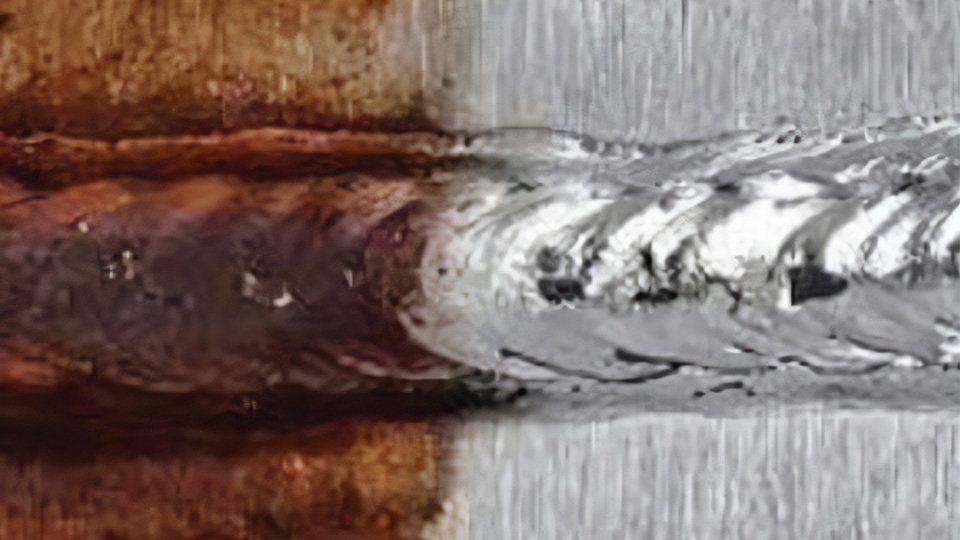
03 Stainless vs. Glass-Fused-to-Steel
GFS tanks (governed by AWWA D103, Factory-Coated Bolted Carbon Steel Tanks) bond a vitreous glass frit to a carbon-steel substrate by firing at roughly 1,500–1,600 °F. The result is a hard, chemically inert surface. The problem is everything underneath and around it.
The substrate has no independent corrosion resistance. Strip the glass off a GFS panel and you have bare carbon steel. The tank's entire service life is staked on keeping a thin (typically 12–20 mil) brittle glass layer continuous and intact — including over bolt holes, at panel cut edges, and across thousands of field connections.
Brittle failure modes that stainless simply doesn't have
- Chipping and impact damage during shipping, erection, and service. Glass is hard but brittle; a dropped tool or a careless lift can fracture the coating.
- Holidays (pinholes) in the as-fired coating — which is why GFS requires holiday/spark testing as standard QA, an admission that breaches are expected.
- Edge coverage at bolt holes and sheared edges, historically the weakest geometry on the panel.
- Thermal-shock and fish-scaling risk from the coefficient-of-thermal-expansion mismatch between glass and steel.
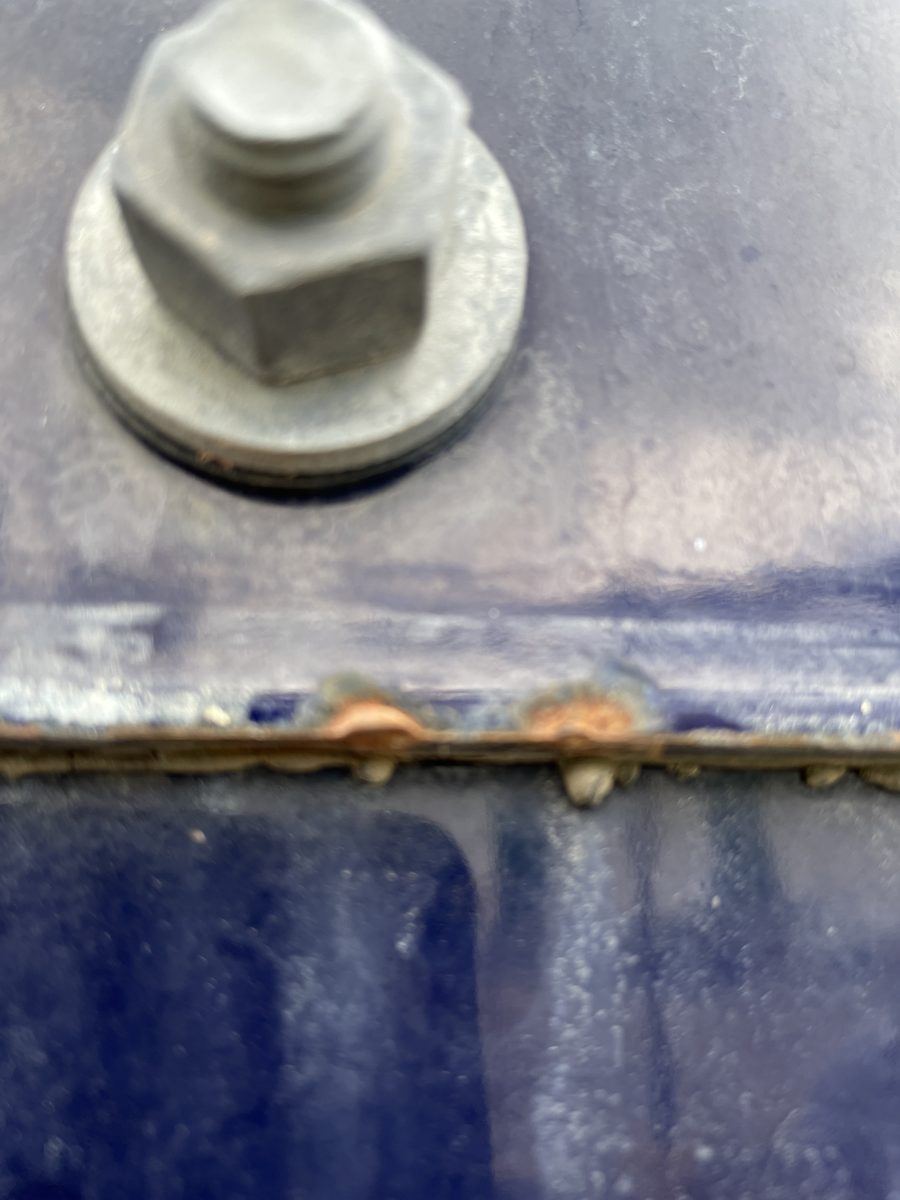
Same erection, no shared vulnerability. A bolted stainless tank is built the same way a GFS tank is — factory-formed panels, field-bolted, gasketed seams. The difference is what sits at the cut edges and bolt holes. On a GFS panel, those are the prime sites for coating breach and corrosion; on a stainless panel, a sheared edge or a drilled hole exposes nothing but more corrosion-resistant stainless. The geometry that is GFS's weakest point is a non-event in stainless.
The cathodic-protection tell. Many GFS tanks are specified with an impressed-current or sacrificial cathodic protection system. Consider what that means: the manufacturer is engineering a second line of defense specifically because they anticipate the glass will be breached and the carbon steel exposed. Stainless tanks in potable service generally require no cathodic protection at all — the wall doesn't corrode, so there is nothing to protect cathodically.
Repairs aren't glass. When a GFS coating is damaged, the field repair is a patch — epoxy, urethane, or a mechanical cap — not re-fired glass. You've now introduced a dissimilar, less durable material at exactly the point that already failed once, and it becomes a recurring maintenance item.
04 Stainless vs. Concrete
Concrete tanks — AWWA D110 (wire- and strand-wound prestressed) and AWWA D115 (tendon-prestressed), plus conventional reinforced designs — are durable in principle but carry degradation mechanisms rooted in the material being porous, alkaline, and reinforced with corrodible steel.
Permeability and leaching. Concrete is not impermeable. Water migrates into the matrix, and in early life calcium hydroxide can leach into the stored water, affecting pH and taste. That moisture transport is the vehicle for the more serious problems below.
Reinforcement corrosion — the core vulnerability. Concrete protects embedded steel through high alkalinity (pH ~13), which keeps rebar passivated. Two mechanisms break that down:
- Carbonation: atmospheric CO₂ reacts with the cement matrix, dropping pH and depassivating the rebar; the expansive corrosion product then spalls the cover concrete.
- Chloride ingress: chlorides from disinfection or the environment penetrate to the steel and locally destroy passivation, driving pitting corrosion of the reinforcement.
In prestressed designs the stakes are higher: corrosion of the prestressing wire under sustained tension can lead to wire breaks and, in worst cases, hydrogen embrittlement — a structural concern, not a cosmetic one — and that wire is buried under shotcrete and difficult to inspect.
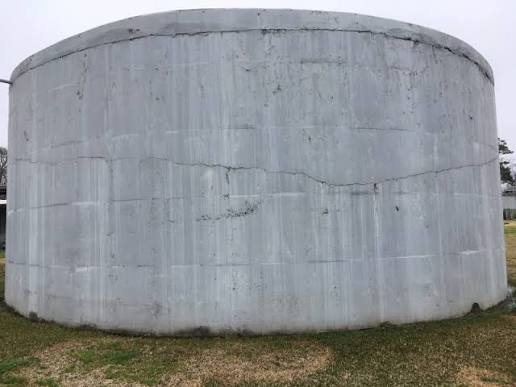
Cracking is a maintenance baseline, not an exception. Shrinkage, thermal cycling, differential settlement, and freeze-thaw all open cracks, and every crack is a leak path and a fresh corridor for chlorides and CO₂ to reach the reinforcement.
Surface, footprint, and schedule. A porous, rough concrete interior is harder to clean and disinfect than a smooth stainless wall and offers more surface for biofilm. Concrete tanks are also heavy, demand substantial foundations, occupy a larger footprint per unit volume, and impose cure time on the schedule. Concrete can deliver a long service life — but it's a maintenance-managed long life of sealant replacement, crack injection, spall repair, and periodic assessment of buried prestressing.
05 Water chemistry: where stainless is quietly forgiving
Potable systems are chemically aggressive by design — free chlorine, chloramine, fluctuating pH, dissolved oxygen, and chlorides are all present, and all attack coating-dependent and concrete systems through the pathways above. Stainless handles this chemistry as a bulk property. Where chloride or chloramine levels are a genuine concern, the response is a straightforward grade selection (316L over 304L), backed by the PREN framework — a documented, defensible engineering decision rather than a hope that a coating stays continuous for 40 years.
06 Lifecycle cost: where the comparison is won
Stainless carries a higher upfront material cost than GFS or concrete. That's the honest tradeoff, and any engineer evaluating these systems should expect it. The case for stainless is made on total cost of ownership, not first cost:
- No recoating cycles. GFS patches and any painted appurtenances are recurring spend; stainless has none.
- No cathodic protection to install, power, monitor, and replace anodes on.
- Minimal structural maintenance versus concrete's crack injection, joint sealant, and spall-repair program.
- Long, low-intervention design life — stainless potable tanks are routinely engineered for 50+ years with the wall itself essentially maintenance-free.
- Residual value. Stainless is fully recyclable with meaningful scrap value at end of life; concrete is a demolition-and-disposal cost.
Integrate maintenance, downtime, recoating, and CP across a multi-decade horizon, and the lifecycle curves cross — stainless typically wins on net present cost for long-design-life potable storage.
07 Side-by-side summary
| Property | 304L / 316L Stainless | Glass-Fused-to-Steel | Prestressed / Reinforced Concrete |
|---|---|---|---|
| Protection mechanism | Inherent passive Cr-oxide film (bulk property) | Applied glass coating over carbon steel | Alkaline matrix passivating embedded steel |
| Governing standard | AWWA D103 bolted-tank design methodology; NSF/ANSI 61 stainless plate, no coating system | AWWA D103 | AWWA D110 / D115 |
| Primary failure mode | Localized pitting only in severe chloride service (mitigated by grade) | Coating chip / holiday → substrate corrosion | Carbonation & chloride-driven rebar/wire corrosion, cracking |
| Coating / recoating | None | Patch repairs over service life | Crack injection, sealant, spall repair |
| Cathodic protection | Not required | Frequently required | N/A (different mechanism) |
| Joints & edges | Bolted panels; cut edges & bolt holes remain solid stainless | Bolted panels; cut edges & bolt holes are prime coating-breach sites | Cast joints + sealant |
| Surface / biofilm | Smooth, non-porous, hygienic | Smooth where intact | Porous, rougher, harder to disinfect |
| Foundation / footprint | Light, small | Moderate | Heavy, large |
| Construction schedule | Fast | Fast | Slow (cure time) |
| Design life | 50+ yrs, wall essentially maintenance-free | Coating-life dependent | Long, but maintenance-managed |
| Upfront cost | Higher | Lower | Variable / lower |
| Lifecycle cost | Lowest for long-life potable storage | Higher (recoating + CP) | Higher (structural maintenance) |
GFS and concrete can both store potable water, and both have a place. But both protect the water by interposing a vulnerable layer — a thin glass coating, or an alkaline cover over corrodible steel — between the substrate and the service environment. The entire risk profile of those tanks is the integrity of that layer over decades.
Stainless steel removes the layer from the equation. The corrosion resistance is the wall. There's no coating to chip, no holiday to test, no cathodic protection to power, no rebar to carbonate, and no recoating cycle to budget for. For long-design-life potable water storage where lifecycle cost and water quality are the priorities, that's a fundamentally stronger engineering position.