
The 20-to-30-year figure on an epoxy-coated tank isn't the life of the tank. It's the recoat interval — and confusing the two is the most expensive mistake in the coated-tank decision.
01 The misconception that costs owners money
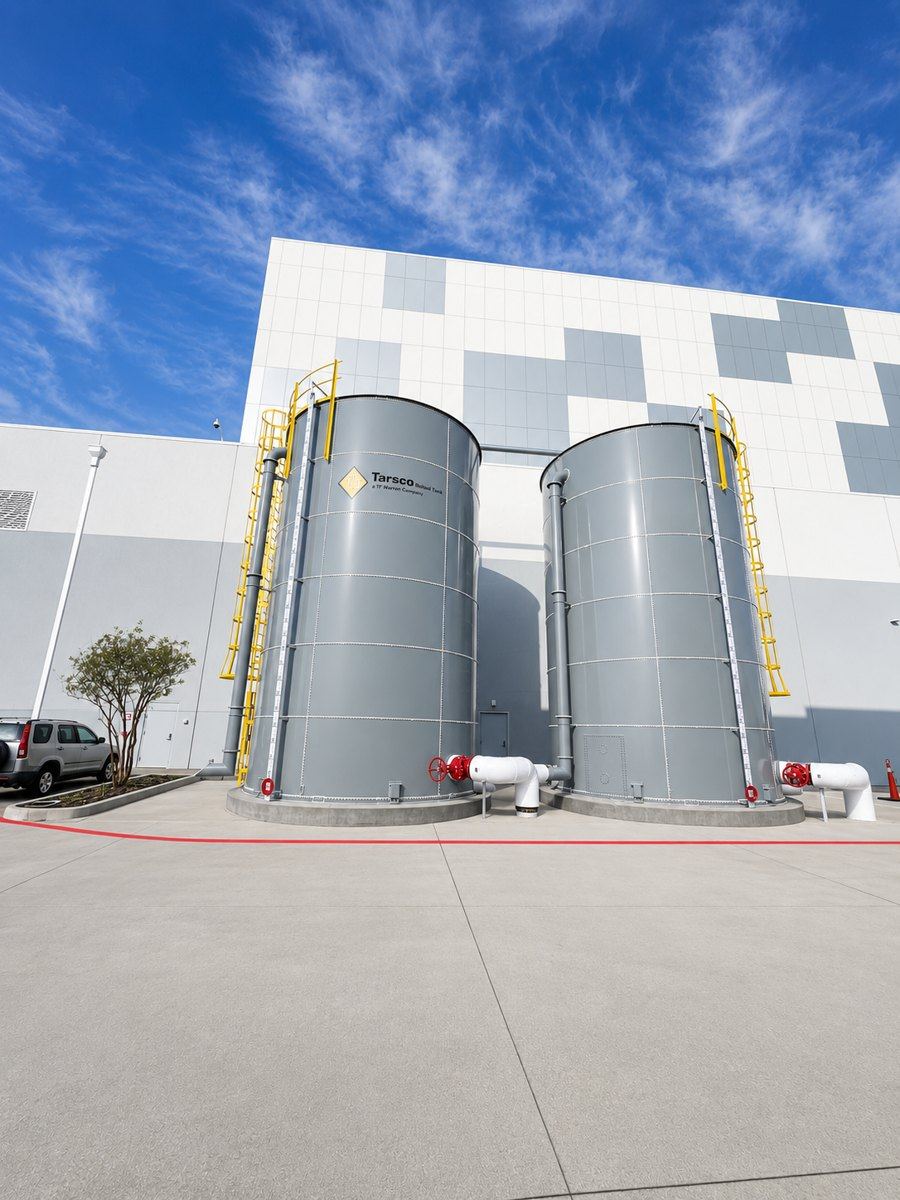
Start with the product. The epoxy tank in this comparison is the factory-coated, fusion-bonded-epoxy (FBE) bolted steel tank built to AWWA D103 — the same panelized, field-bolted construction as a glass-fused-to-steel tank, but with an epoxy coating instead of fused glass. The 20-to-30-year number describes how long that coating system performs before it's due for maintenance — not the end of the asset. Treating it as the tank's lifespan is the costly error.
The shell underneath is structural steel, engineered to serve for many decades. The coating is the renewable element on top of it. When a buyer hears "20–30 years" and pictures a tank that gets thrown away, they're confusing a scheduled maintenance event with end of life — and they may pass over the option that's actually cheaper to own.
02 Recoatability changes the lifecycle math
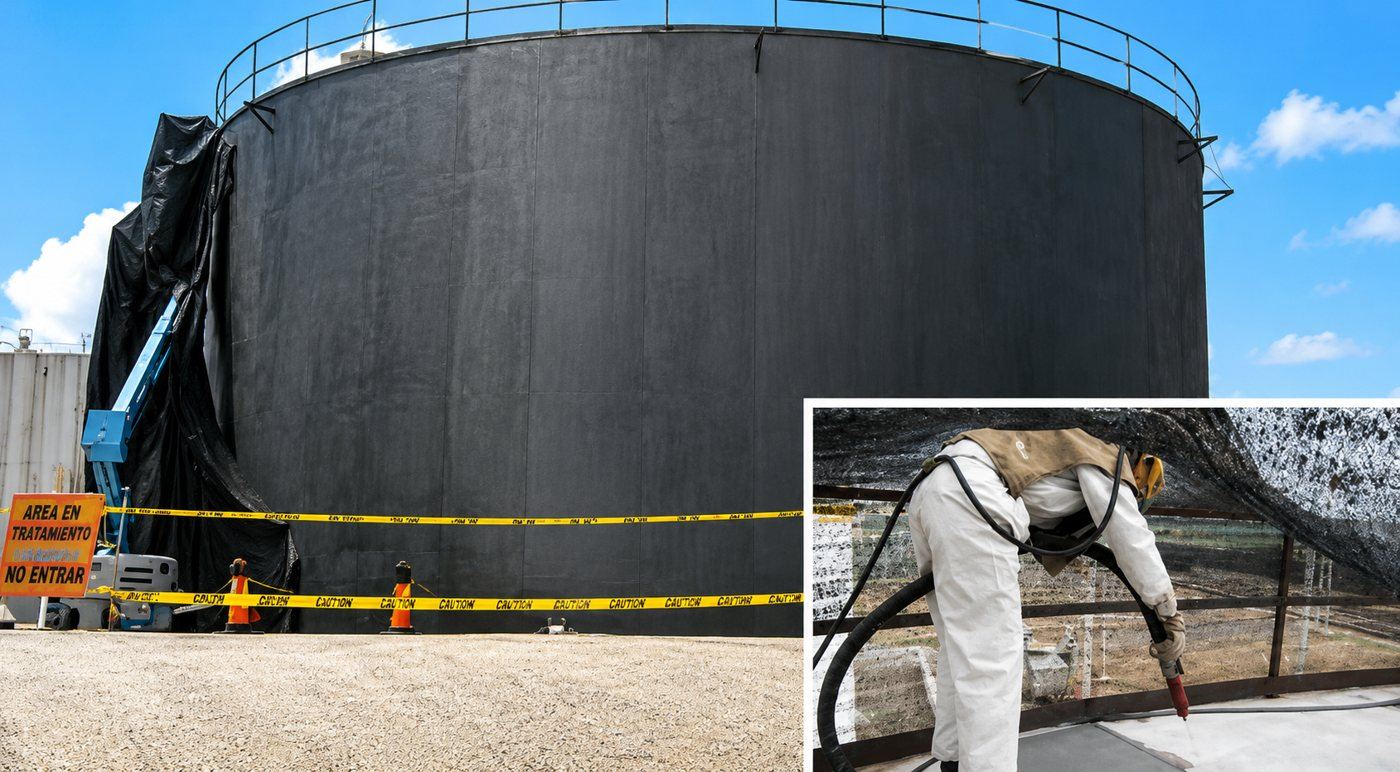
The factory FBE coating is durable, and when it eventually needs renewal the steel shell is abrasive-blasted and re-lined in place with a compatible liquid epoxy system. This is neither novel nor risky: steel water tanks have been maintained by field recoating for more than a century. It's one of the most established practices in the industry.
A recoat is a planned, schedulable, budgetable event at a fraction of replacement cost. Run that cycle a couple of times over the tank's structural life and the working service life of an epoxy-coated tank commonly reaches two to three times the practical service life of a comparable glass-fused-to-steel (GFS) tank.
Recoat interval ≠ service life. The coating is renewable; the steel shell is the long-life asset.
03 The glass-fused-to-steel problem: you can't recoat glass
GFS is durable while it's intact, but it has a hard ceiling: the coating cannot be renewed. Vitreous glass is fused to the steel at roughly 1,500 °F in a factory furnace, and there is no field equivalent — you cannot reproduce furnace firing on an erected tank.
So when a glass coating reaches the end of its life, or is breached beyond what a patch can address, rehabilitating the shell means stripping the glass — a process whose labor and cost can approach that of a new tank. In practice, the only true option at GFS coating failure is replacement of the system.
That's the difference that matters to an owner's budget. The epoxy path absorbs a modest, predictable recoat decades down the road. The GFS path triggers an unplanned capital outlay — effectively a second tank — the day the glass fails.
04 Epoxy in potable water service
For potable storage, the FBE bolted tank pairs a factory-applied fusion-bonded epoxy coating with the AWWA D103 bolted shell. The powder epoxy is applied and heat-cured on each panel under controlled shop conditions; the panels are then field-bolted — the same erection as a GFS tank, but with a coating that can be renewed.
FBE systems are available NSF/ANSI 61-certified for potable contact. The wetted surface is smooth, cleanable, and selected to stand up to free chlorine and chloramine. Quality is verifiable on installation and at every renewal: dry-film-thickness (DFT) readings, holiday/spark testing for coating continuity, and pull-off adhesion testing. The coating is inspectable — which is exactly what makes it maintainable. When the factory coating is eventually due, the steel is field-recoated with a compatible liquid epoxy lining; the glass on a GFS panel has no such option.
05 Epoxy in wastewater service
Wastewater is a more aggressive environment, and it's where coating selection earns its keep. The dominant attack mechanisms:
- Biogenic sulfide corrosion. Hydrogen sulfide off-gasses from the liquid, and Thiobacillus bacteria in the humid headspace oxidize it to sulfuric acid. The vapor and splash zones above the waterline are typically the most corrosive part of the structure.
- Microbiologically influenced corrosion (MIC) at and below the waterline.
- pH swings, chlorides, fats/oils/grease, and grit abrasion depending on the process.
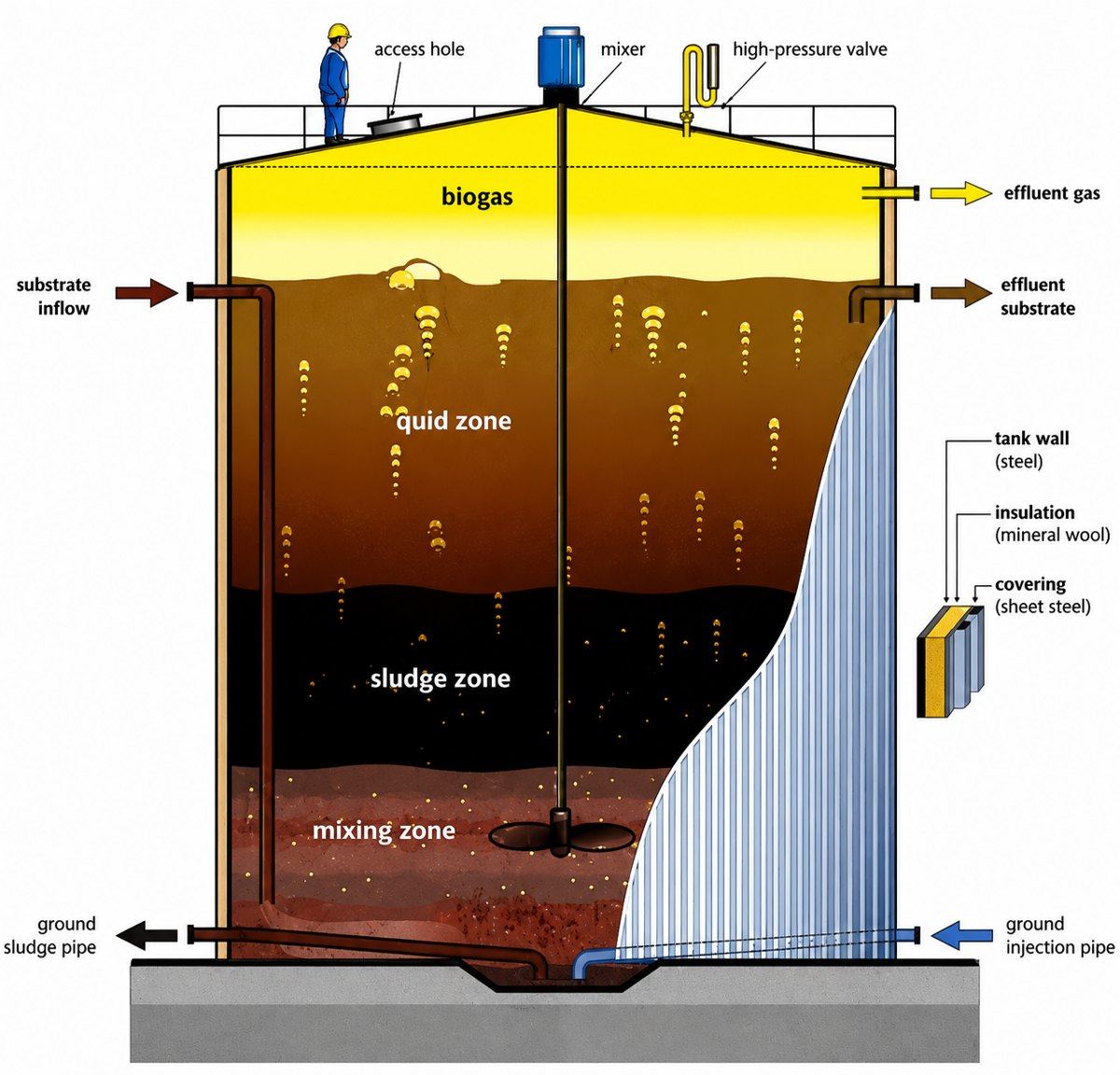
The practical answer is zone-specific coating selection. Standard immersion-grade epoxy handles the submerged zone; a novolac epoxy or a reinforced polyurethane/polyurea system is specified for the acidic headspace and splash zones. Typical applications include flow-equalization (EQ) tanks, sludge and biosolids storage, digesters, and SBR/MBBR basins.
The recoatable advantage is even stronger here than in potable service: wastewater chemistry and process loads evolve over a tank's life, and a coated steel tank can be re-prepped and re-lined — or upgraded to a more chemically resistant system — at the next maintenance cycle. A fused-glass tank offers no such path.
06 Specifying and maintaining the system
A durable epoxy system is a specification discipline, not a coincidence:
- Surface preparation to the exposure — near-white metal blast (SSPC-SP10 / NACE No. 2) for immersion service.
- DFT to the manufacturer's specification, verified across the surface.
- Holiday/spark testing to confirm coating continuity over seams, edges, and fittings.
- Adhesion testing (ASTM D4541 pull-off) where the spec calls for it.
- A written inspection and recoat program: periodic interior inspection, spot repair of localized damage, and a full recoat on cycle.
None of this is a burden — it's the feature. An inspectable, renewable coating gives the owner a maintenance plan with known costs and intervals. Fused glass gives the owner a coating that can only be assessed, never renewed.
07 The bidding engineer's lifecycle view
| Property | FBE Bolted Steel | Glass-Fused-to-Steel |
|---|---|---|
| Coating type | Factory-applied fusion-bonded epoxy (FBE) | Vitreous glass fused to steel |
| Governing standard | AWWA D103 (factory-coated bolted) | AWWA D103 (factory-coated bolted) |
| Field-recoatable? | Yes — steel re-lined with liquid epoxy in the field | No — requires factory furnace firing |
| End-of-coating-life option | Scheduled recoat | System replacement |
| Local damage repair | Spot-blast and patch with matching epoxy | Patch with a dissimilar, non-glass material |
| Lifecycle cost trajectory | Predictable recoat cycles | Step change to replacement at failure |
| Potable certification | NSF/ANSI 61 systems available | NSF/ANSI 61 |
| Wastewater suitability | Zone-specific systems; upgradeable at recoat | Limited by non-repairability in aggressive service |
When you weigh first cost against a multi-decade ownership budget, the recoatable epoxy tank is the more defensible coated option. A known maintenance line item beats a future tank replacement every time.
Epoxy-coated steel tanks are not a short-life compromise. They're a long-life, maintainable asset whose defining advantage is that the protective system can be renewed in place — on a schedule, within a budget, for as long as the steel serves.
Across both water and wastewater, that recoatability is the line between a tank you maintain and a tank you replace.